 SartoriaBookBook a consultation
For custom builders
Selections worthy of the homes you build.
Every finish chosen, priced against its allowance, and signed off in writing.
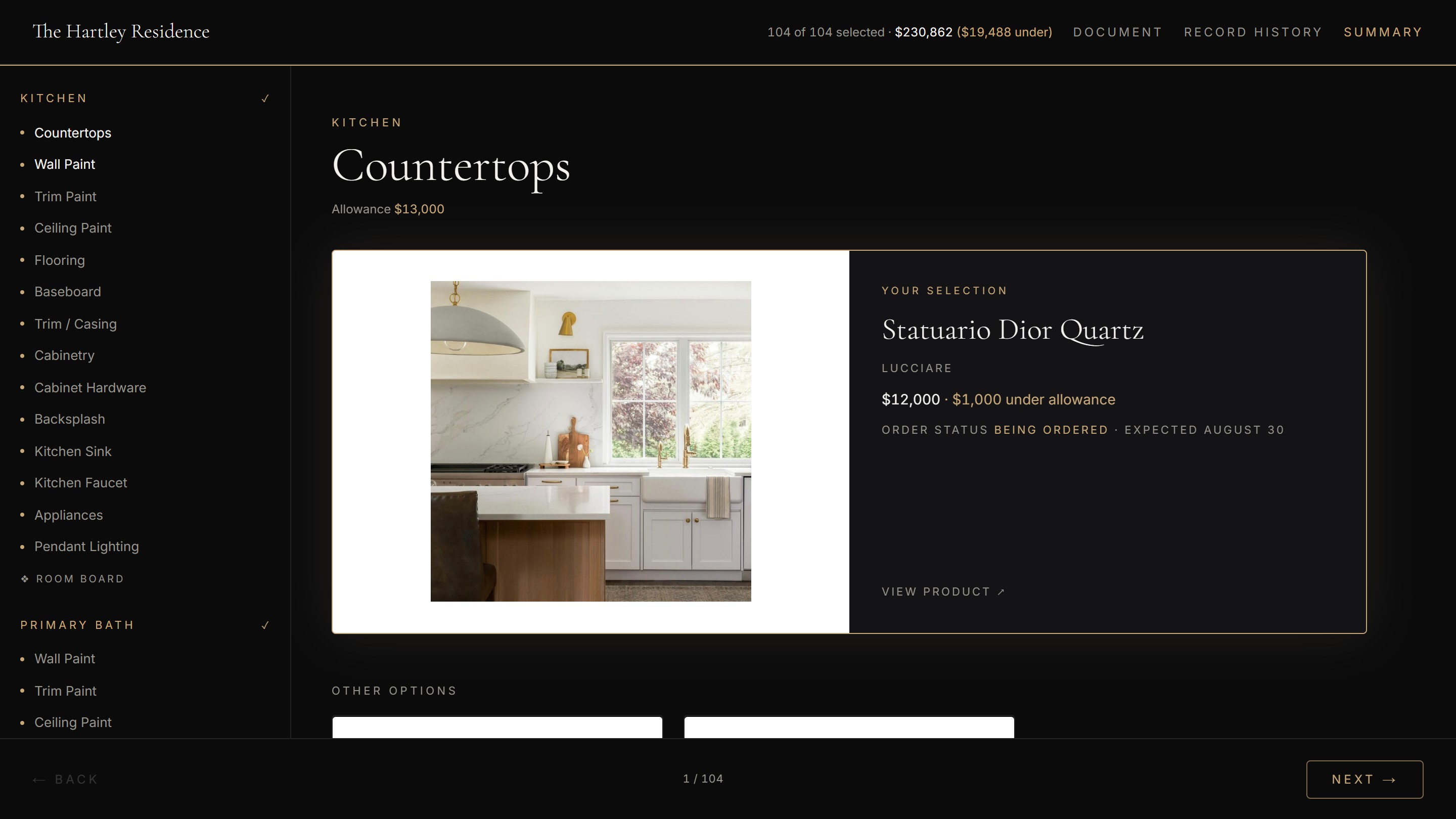
You've spent twenty years perfecting how your homes are built. Your clients spend eight months experiencing how they're chosen.
The problem
The selections process is where custom homes go to feel un-custom.
Your client just committed seven figures to the most personal purchase of their life. Then you handed them a spreadsheet.
- The 47-tab spreadsheet
- Allowances in one tab, decisions in another, the “final-FINAL” version in an email from March. Nobody, including you, is sure what's current.
- The email archaeology
- A $4,200 change order becomes a memory contest between your PM and your client's sister-in-law.
- The stalled schedule
- Cabinets needed a decision three weeks ago. The client isn't slow — they're choosing blind from a laminate binder.
The experience
Choosing the finishes should be the best part of building the house.
For most clients it is the part they dread. Eight months of decisions made from a binder, in a showroom, on a Tuesday afternoon they had to take off work.
The reveal
Every option, presented like it deserves to be chosen.
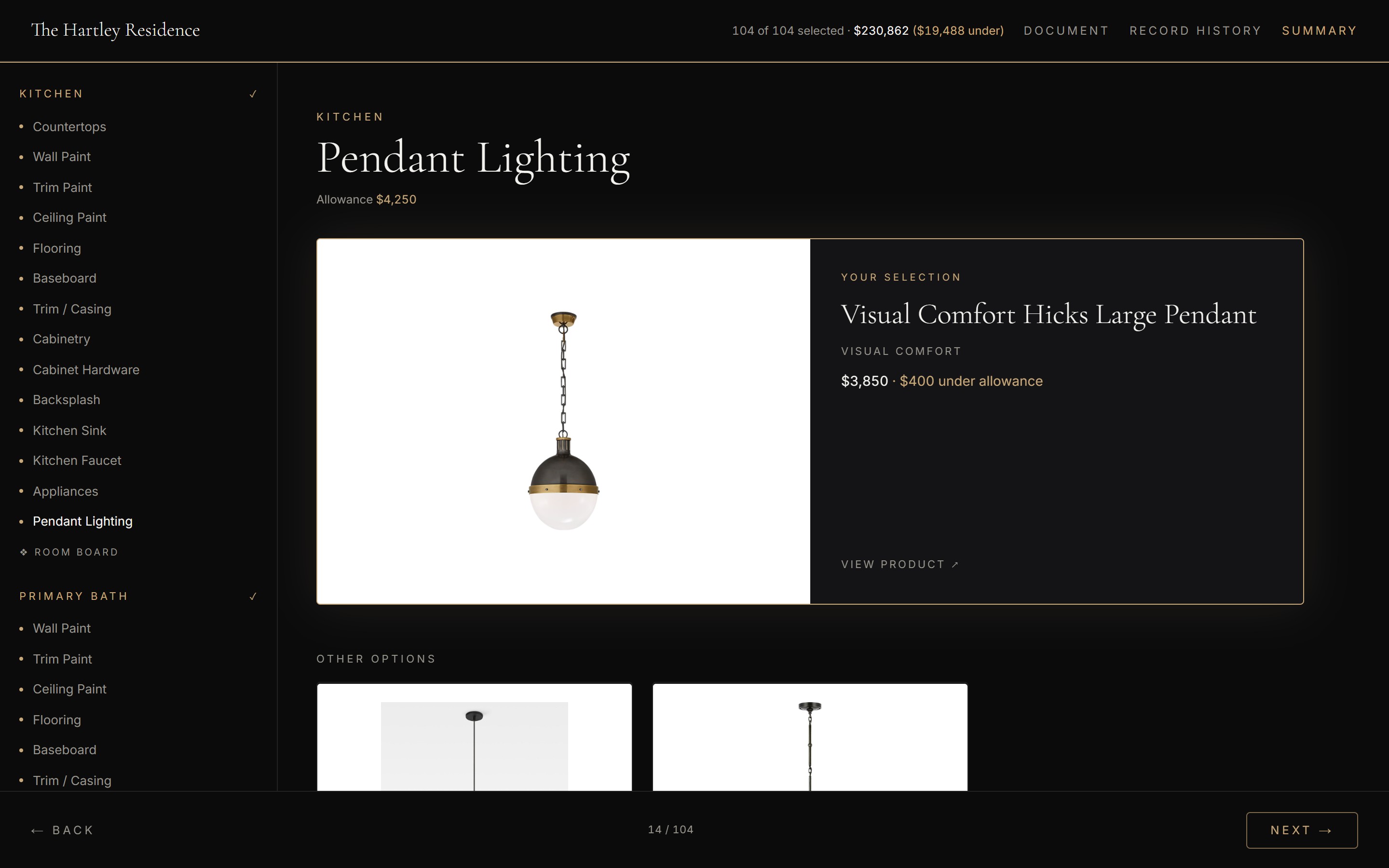
Your finishes, large, room by room — not a binder and a one-inch swatch. Clients browse their future home the way they'd browse anything else they were excited to buy.
The decision
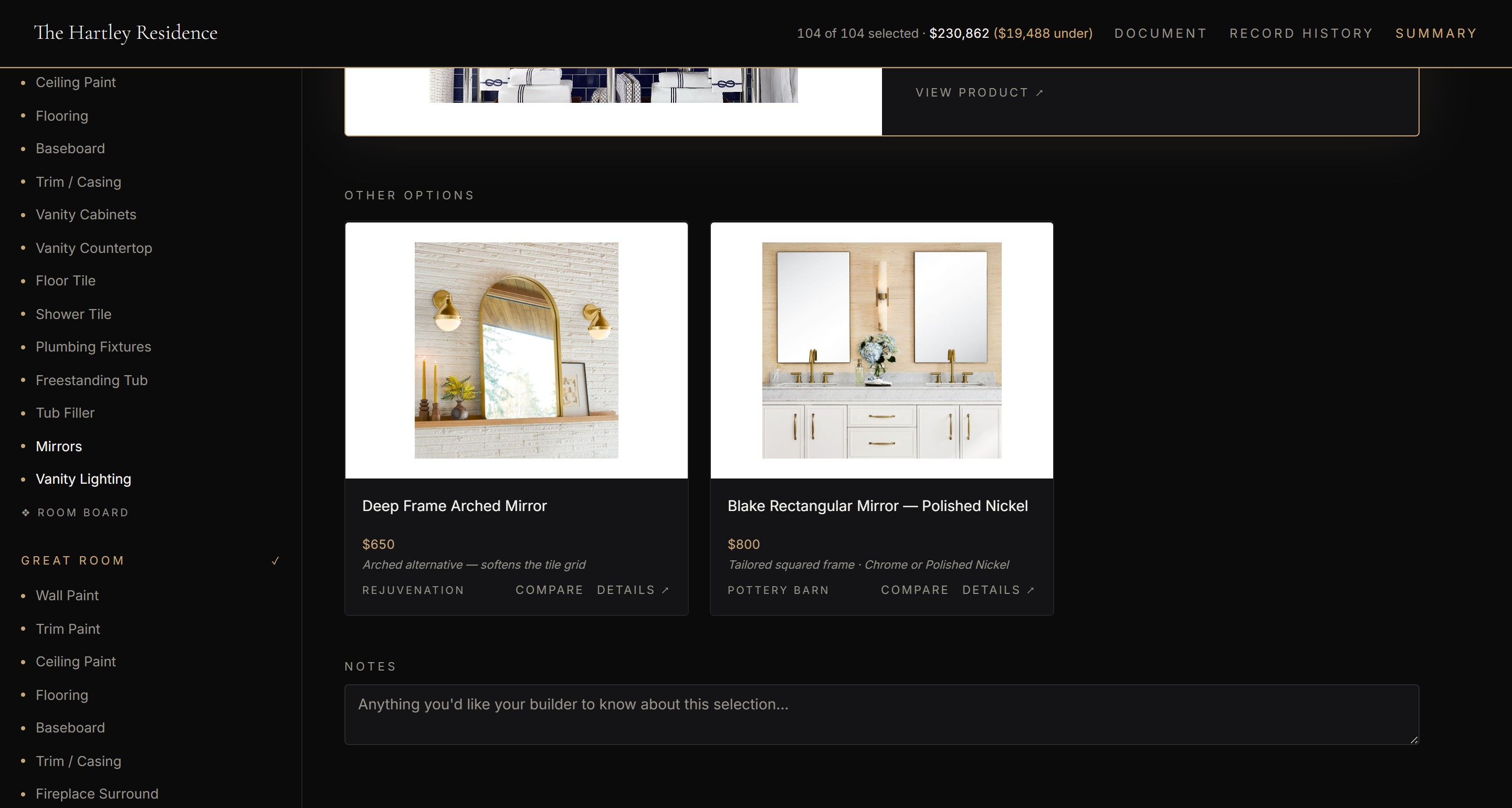
The price is on the table, so decisions actually happen.
Live allowance tracking with every choice. Your client sees exactly what upgrading costs before they ask, then confirms with a tap that prices, dates, and documents it.
After the choosing
A selection isn't finished when it's chosen. It's finished when it's installed right.
The trades
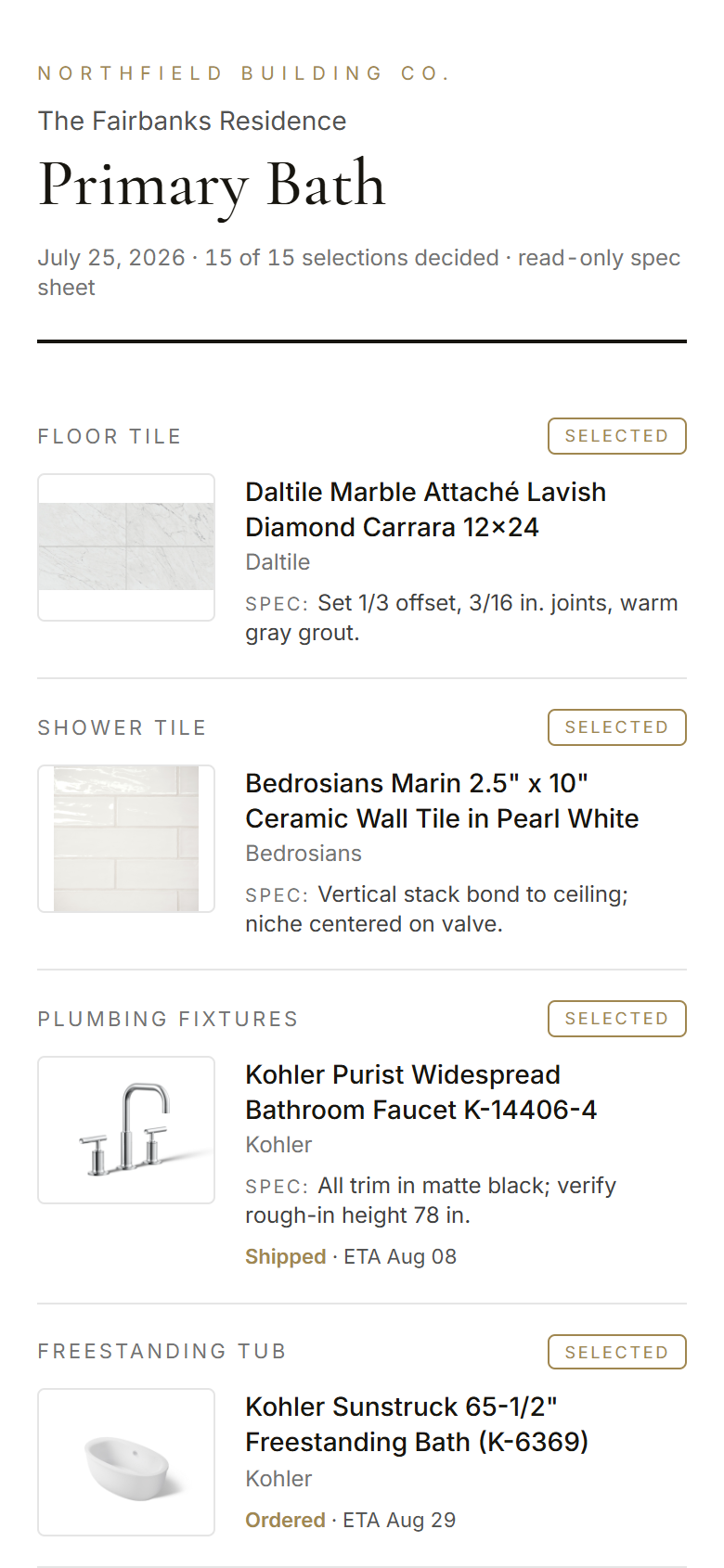
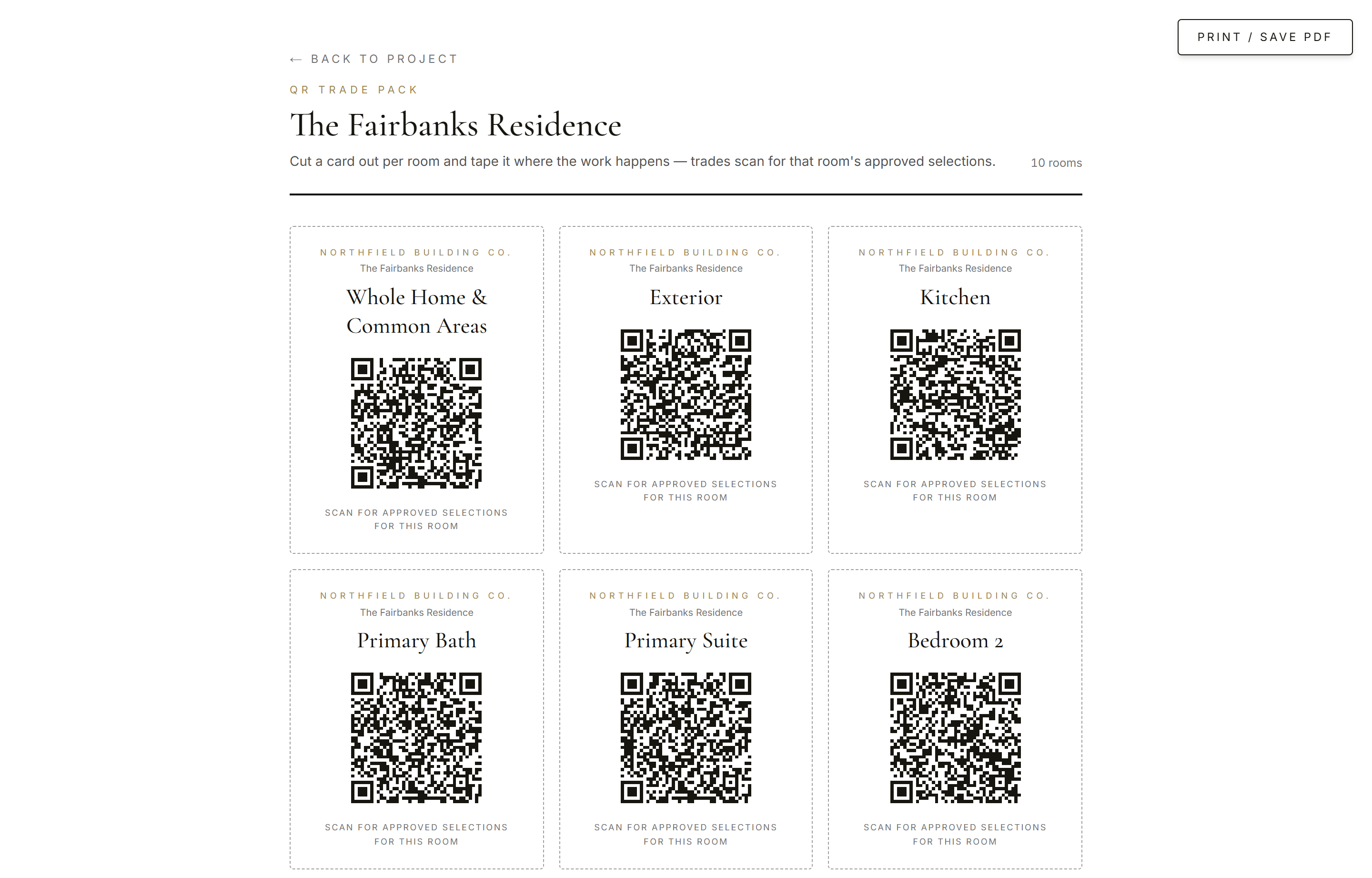
A QR code in the room. The right spec on the installer's phone.
Print a card for each room and tape it to the wall. Whoever is working there scans it and sees what was selected — product, finish, quantity, and the manufacturer's own spec sheets. No prices, no login, nothing they can change. Print a new pack and the old codes go dead.
The board & the finish book
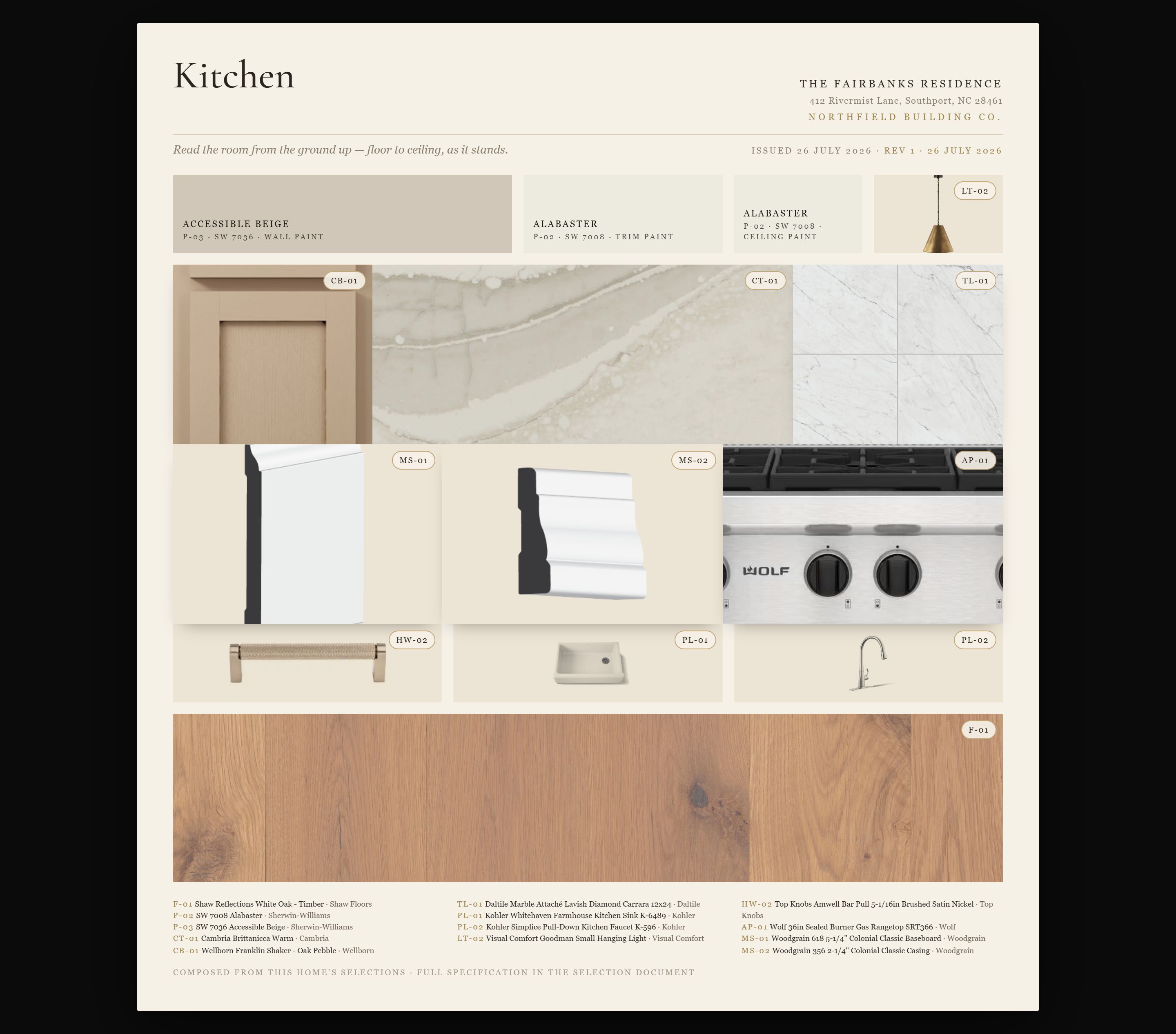
The material board a design firm would build, without the afternoon.
Every room composes its own board from what's been selected — flooring anchored at the bottom, paint as true-color chips at the top, the materials that touch in the room touching on the board. Each one carries a title block and a typeset spec key. Bind the rooms together and you have the finish book, with a closing schedule grouped by material. It prints on one page and updates itself when a selection changes.
Your name on it
Your company on everything. Not ours.
Your name, logo, and tagline on the client's pages, the printed record, the finish book and the trade cards. Your clients and your subs see your company; the software stays out of the way. Setting it up takes about a minute.
The record
Month seven. “We never approved that tile.”
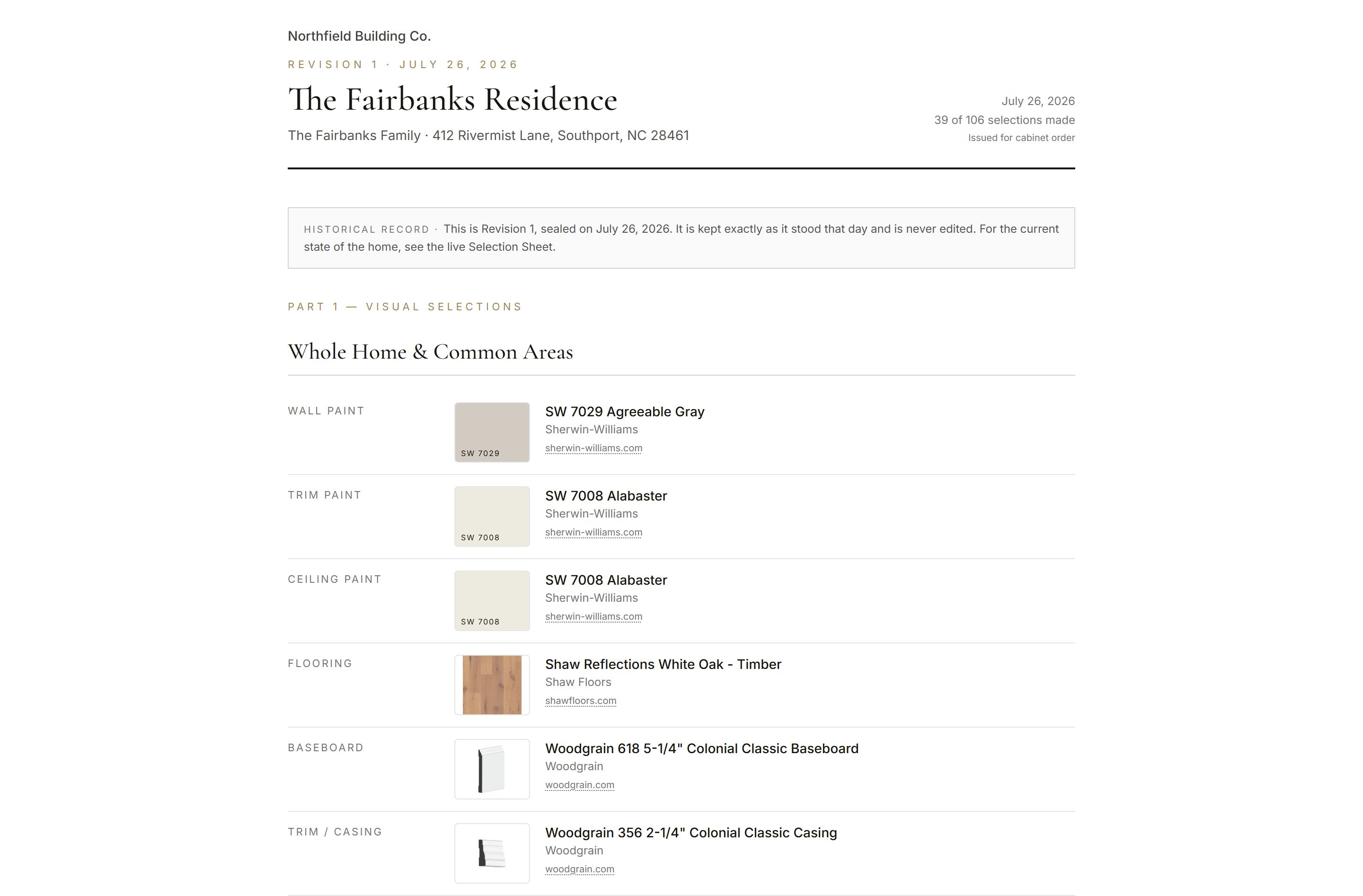
Today that costs you an afternoon in your sent folder and, often enough, the difference. Sartoria's answer is a revision: a dated record of exactly what had been decided the day you published it, sealed when it's cut and printable years later exactly as it stood. Your client has been able to read those same records on their own link the whole time — so you're comparing documents, not memories. Put any two side by side and the change reads in plain English.
Pricing
One plan. The whole price.
Not a starting price, not the small tier. There is nothing above this one to be upsold into, and nothing here is billed by how many homes you build.
$399/month
or $3,990/year — two months free
- ·Every job, every client, every selection
- ·Unlimited client access — your homeowners never need an account, and you're never charged for one
- ·Trade sheets and QR packs for your subs, at no charge
- ·No per-user fees, no setup fee, no volume bands
- ·We load your first plan's selections with you
Bring one current plan and we'll build the configurator for it live. No contract talk on the first call.
About
I didn't learn about selections chaos from a market report. I learned it from a Tuesday.
The Tuesday in question involved a client in tears over a backsplash, a spreadsheet with three conflicting “final” tabs, a tile order already sitting on the slab, and a $3,800 question about who approved what — answerable only by scrolling through four months of email.
I spent years inside a custom homebuilding operation, in the seat where selections live. I built the spreadsheets. I sent the reminder emails. And these same clients could configure a car online in twenty delightful minutes, then come to us for a purchase five times larger and infinitely more personal, and we'd hand them a spreadsheet. The builders weren't behind. The tools were.
When you book a consultation, you talk to someone who has personally chased a client for a plumbing-fixture decision at 9pm so a rough-in wouldn't slip. Not a sales team.
Before you ask
Will my clients actually use it? Some of them hate apps.+
If they can shop online, they can use this. No app store, no password to invent — they open a link and tap the finishes they love. The clients who hate apps tend to hate binders more.
How long does setup take?+
Your first plan is live in about a week and we do the heavy lifting. Send us your current selection sheet — yes, the spreadsheet — and we build it out with you in one working session.
My subs aren't going to log into another system.+
They don't. You tape a card up; they scan it and get a read-only spec sheet on their phone. No account, no password, no prices, nothing they can change.
We already use Buildertrend or JobTread. Is this redundant?+
No — it's the layer they're missing. Your PM software was built for you and your subs; it was never designed to face your client. Sartoria handles the selection experience and hands clean, documented decisions to whatever runs your schedule.
What happens to my data if I leave?+
It's yours and you don't have to ask for it. Every selection exports as a spreadsheet, and the record, the finish book and the trade sheets all print. Same button whether you're staying or going.
What Sartoria does when it can't prove a number — read the rules we hold ourselves to.
Somewhere tonight, your client is configuring a car they want less than the home you're building them.
Give the bigger purchase the better experience.
Book a 20-Minute Consultation